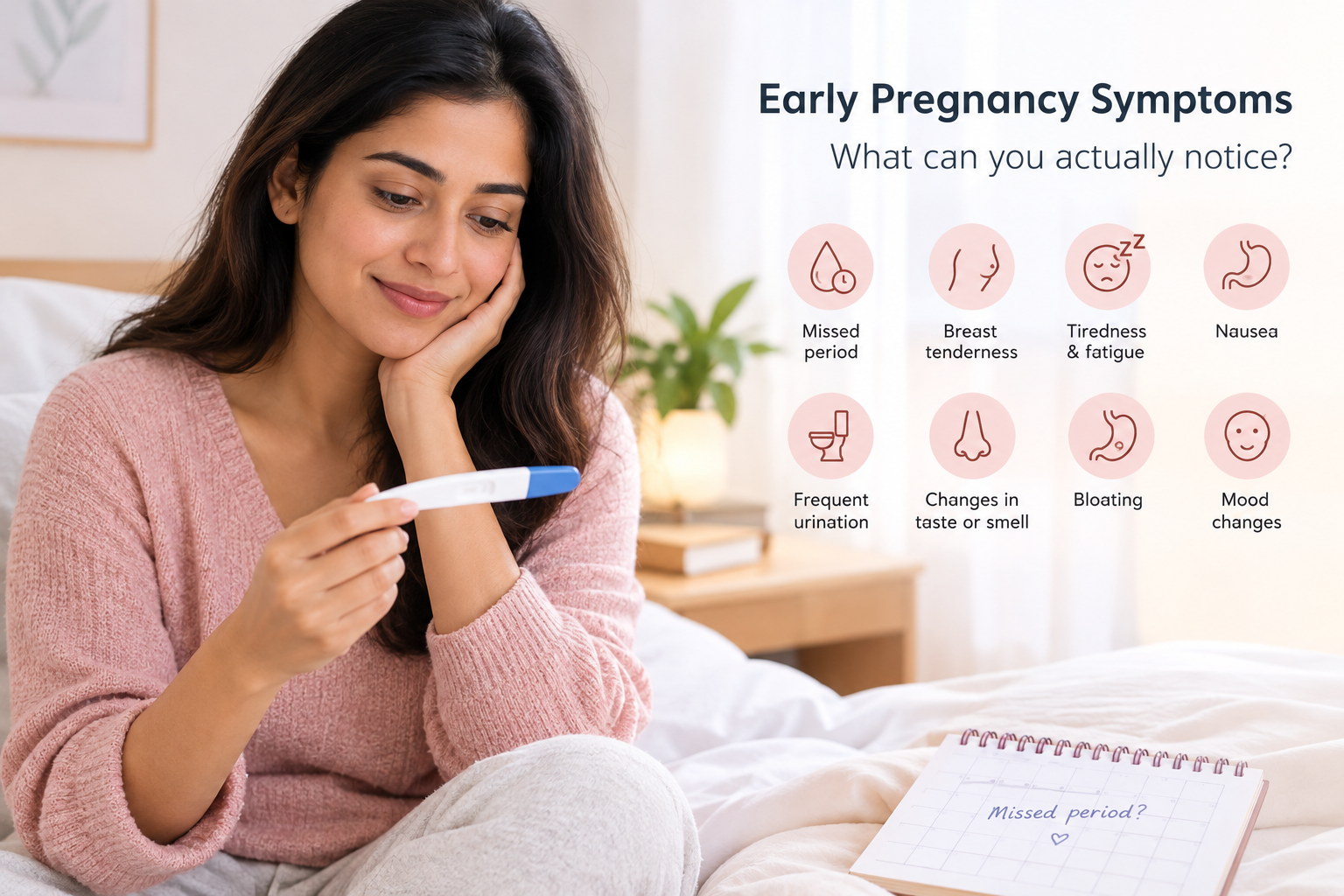
If you are trying to conceive, a late period can make you notice every small change in your body. You may wonder whether tiredness, breast soreness, nausea, bloating or increased urination means you are pregnant. The important thing to know is that early pregnancy symptoms vary widely. Some women notice several changes, while others have almost no symptoms in the first few weeks. Symptoms can also overlap with premenstrual symptoms, so they cannot confirm pregnancy on their own. A missed period is one of the most common early signs of pregnancy, but it is not the only one. Early pregnancy may also cause tiredness, breast tenderness, nausea, increased urination, changes in taste or smell, bloating, mild cramping, mood changes and increased vaginal discharge. However, these symptoms can also occur before a period. A pregnancy test is the practical way to confirm whether pregnancy is likely.
When do pregnancy symptoms start?
Pregnancy is dated from the first day of your last menstrual period, so the first few weeks of pregnancy can be confusing. Some women do not notice any symptoms at all initially. When symptoms do occur, they commonly become noticeable around the time of a missed period or during the following weeks.
This means there is no single day when every woman should expect pregnancy symptoms. Your experience may also be different from a previous pregnancy.
What are the common early pregnancy symptoms?
Early pregnancy can cause a range of physical and hormonal changes. Some women notice several symptoms, while others notice very little during the first few weeks.
The following symptoms can occur in early pregnancy, although none of them can confirm pregnancy on their own.
- Missed or unusually late period
- Breast tenderness, fullness or soreness
- Unusual tiredness or fatigue
- Nausea, with or without vomiting
- Needing to urinate more frequently
- Increased sensitivity to smells
- Changes in food preferences, cravings or loss of interest in certain foods
- A metallic taste in the mouth
- Bloating
- Mild cramping that can feel similar to period pain
- Mood changes
- Increased vaginal discharge without soreness or irritation
Is a missed period always a sign of pregnancy?
No. Pregnancy is an important reason for a missed period, particularly if you have had unprotected sex, but periods can also become late for other reasons.
Stress, changes in weight, intense exercise, hormonal conditions and some medical problems can affect the menstrual cycle.
If your period is repeatedly irregular or you are frequently missing periods, it is worth discussing the pattern with a gynecologist rather than assuming pregnancy is the only explanation.
Pregnancy symptoms vs PMS: why can they feel so similar?
Early pregnancy and the days before a period can produce similar symptoms. Breast tenderness, bloating, tiredness, mood changes and mild cramping can occur with both.
This is why trying to diagnose pregnancy from symptoms alone can create unnecessary confusion. A symptom that feels unusual for you may make pregnancy more likely, but it does not confirm it.
A pregnancy test is more useful than symptoms alone when you want to know whether you are pregnant.
Can you have pregnancy symptoms before a missed period?
Some women notice changes before their expected period, while others do not notice anything. Very early symptoms can be subtle and may be difficult to distinguish from normal premenstrual changes.
If you are testing before your expected period, remember that testing too early can give a negative result even when pregnancy has occurred. The timing of testing matters.
When should you take a pregnancy test?
Most home pregnancy tests are most reliable from the first day of a missed period. If you do not know when your period is due, testing at least 21 days after the last unprotected sexual intercourse can be a useful timing rule.
A positive home pregnancy test is generally reliable when the instructions have been followed correctly. A negative result can be less reliable if the test was taken too early.
If your period still has not arrived and you continue to think you may be pregnant, repeating the test after a few days or discussing it with your gynecologist can help.
What if you have no pregnancy symptoms?
Having no symptoms does not mean that you are not pregnant. Some women have very few noticeable symptoms during the early weeks.
Symptoms also vary according to the individual and can change as pregnancy progresses. Comparing your symptoms with another woman's experience, or even with a previous pregnancy, is therefore not a reliable way to determine whether you are pregnant.
What about light spotting or cramping?
Light spotting or mild cramping can occur around early pregnancy, but these symptoms are not specific to pregnancy and should not be used to confirm it.
Bleeding or pain during pregnancy should be discussed with a healthcare professional, particularly if it is persistent, heavy or associated with significant pain.
When should you contact a gynecologist?
Most early pregnancy symptoms do not require urgent medical attention. However, some situations should be assessed by a gynecologist, particularly when pregnancy is possible or has already been confirmed.
- Your pregnancy test is positive and you want to discuss the next steps
- Your period is repeatedly late or irregular without a clear reason
- You have a positive pregnancy test with vaginal bleeding or significant abdominal or pelvic pain
- You have severe or worsening one-sided pelvic pain, particularly with bleeding or dizziness
- You have repeated negative pregnancy tests but your period remains absent
- You are trying to conceive and have concerns about your menstrual cycle or fertility
The takeaway
Early pregnancy symptoms can include a missed period, breast tenderness, tiredness, nausea, increased urination, changes in taste or smell, bloating, mild cramping and mood changes.
But there is no fixed list of symptoms that every woman experiences. Some women notice several changes, while others have few or no noticeable symptoms during the early weeks.
Because many early pregnancy symptoms overlap with PMS and other causes of menstrual changes, a properly timed pregnancy test is more useful than symptoms alone.
Resources
Common questions
What are the first signs of pregnancy?
A missed period is one of the most common early signs. Other possible symptoms include breast tenderness, tiredness, nausea, frequent urination, changes in taste or smell, bloating and mood changes.
Can you have pregnancy symptoms before a missed period?
Yes, some women notice changes before their expected period, but symptoms can be very subtle and may feel similar to PMS. Symptoms alone cannot confirm pregnancy.
Can I be pregnant without having any symptoms?
Yes. Some women have few or no noticeable symptoms during the early weeks of pregnancy. The absence of symptoms does not rule out pregnancy.
When should I take a pregnancy test?
Most home pregnancy tests are most reliable from the first day of a missed period. If you do not know when your period is due, testing at least 21 days after the last unprotected sexual intercourse can be useful.
Can PMS symptoms feel like early pregnancy symptoms?
Yes. Breast tenderness, tiredness, bloating, mood changes and cramping can occur with both PMS and early pregnancy. A pregnancy test is more reliable than symptoms for confirming pregnancy.
What should I do if my pregnancy test is negative but my period has not come?
A test taken too early can be negative even when pregnancy has occurred. If your period remains absent, repeat the test after a few days or speak with a gynecologist, particularly if your cycles are usually regular.