If you're past 35 and thinking about a first or second pregnancy, here's the honest version, without the alarm bells. Your chance of conceiving in any given month is lower than it was at 28. Miscarriage risk is a little higher too. And the window to act on that information calmly, instead of panicking into a rushed decision, is narrower than it feels. None of that means you can't have a healthy pregnancy. Most women who come to me after 35 do. But the plan has to be built around your actual numbers, not around the two extremes you'll hear from friends and family: "you're fine, stop stressing" on one side, "your clock has basically stopped" on the other. Neither is true for most women, and believing either one just stops you from doing anything useful.
What actually changes after 35
Two things decline at the same time, and people tend to lump them together as one. That's where most of the confusion starts.
Egg quantity has been dropping since before you were even born. You're born with every egg you'll ever have, somewhere between one and two million of them. By puberty that's already down to around 300,000 to 400,000, and it keeps falling every year after that, regardless of periods, pregnancy, or contraception. The pace picks up noticeably in your mid-30s, and by 40 only a small fraction of the original count is left.
Egg quality declines on its own separate timeline, and honestly, it's the one that matters more for pregnancy outcomes. As eggs get older, the cellular machinery that splits chromosomes correctly during division gets less reliable. More eggs end up with the wrong number of chromosomes: some fail to fertilise, some fail to implant, some end in an early miscarriage, and a smaller number lead to a chromosomal condition like Down syndrome. This is the real reason miscarriage rates roughly double between your late 20s and late 30s, then roughly double again after 40.
Neither of these gives you any warning. Your cycles can stay perfectly regular, your periods can look completely normal, and your egg quantity and quality can still have moved well past where they were ten years earlier. That's exactly why this conversation needs to happen on a timeline, not wait for a symptom that never shows up.
Why 35 is the number doctors use
Thirty-five isn't an arbitrary cutoff someone picked to worry you. It's roughly where several separate trend lines start bending more steeply at around the same time: monthly conception rates, miscarriage rates, and the proportion of chromosomally normal eggs. It's also, practically speaking, the age at which fertility guidelines change how long you should keep trying before seeking help.
This isn't a message to panic on your 35th birthday. It's a message that waiting another two or three "let's see" years genuinely costs more after 35 than it did before, and that a fertility work-up at this stage is low-risk and high-information, worth doing early rather than late.
- Under 35: a full 12 months of regular, unprotected intercourse without conception is a reasonable point to seek evaluation
- 35 and older: that window shortens to 6 months
- 40 and older: evaluation is recommended without waiting, since there's much less room to lose time on trial and error
AMH testing: what it tells you and what it doesn't
Anti-Müllerian hormone, or AMH, is the blood test most women have heard of, and also the one most women misunderstand. It's produced by the small follicles in your ovaries, and it correlates reasonably well with how many eggs you have left, your ovarian reserve. That makes it a genuinely useful test, but it comes with three real limits worth knowing.
What AMH is good for: predicting how your ovaries are likely to respond to stimulation medication if you go through IVF. That's exactly why fertility clinics lean on it so heavily. It also gives a rough, population-level sense of where your reserve sits compared to other women your age.
What AMH can't do: it says nothing directly about egg quality, only quantity. A woman with a "good" AMH at 39 can still have a high proportion of chromosomally abnormal eggs, because quality is driven mostly by age, not reserve. And a low AMH doesn't mean you can't conceive naturally. Studies following women trying to conceive on their own have found very similar month-to-month pregnancy rates across a wide range of AMH levels, as long as ovulation is happening normally. AMH was never built as a natural-fertility test, it was built to guide IVF planning, and treating it as a stand-alone verdict on your fertility is probably the most common way this test gets misread.
As a rough, population-level reference: median AMH runs around 2.5 to 3 ng/mL in the late twenties, drops to somewhere near 1.4 to 1.5 ng/mL by 35, and settles close to 1 ng/mL by 40. There's enormous variation between individual women at every age, which is exactly why one AMH number, on its own, should never carry a major decision. It's one input in a fuller picture that also includes antral follicle count on ultrasound, your cycle history, and, if relevant, your partner's semen analysis.
Egg freezing: does it make sense for you
This is the question I get most often in this age group, usually somewhere between "not planning to conceive yet" and "not sure when."
The honest, data-backed answer: egg freezing works best as an early insurance policy, not a late rescue plan. Outcomes tracked across large fertility centres show a fairly clear pattern by age at freezing, laid out below.
The practical takeaway is a blunt one. If you're seriously considering egg freezing, doing it now instead of in two or three years matters more than most people assume, because the number that counts isn't your age today, it's your age when you freeze relative to your eggs. Freezing at 36 instead of 34 is a meaningfully different starting point.
It's also worth being upfront about what egg freezing doesn't do. It doesn't guarantee a baby, it improves your odds later by locking in today's egg quality instead of some future age's quality. Only around 15 to 20 per cent of women who freeze eggs electively ever come back to use them, often because they end up conceiving naturally in the meantime. That's not a reason to skip the conversation. It's a reason to have it without assuming freezing is either pointless or a guaranteed fix.
- Under 35: the strongest outcomes. Women who freeze 15 to 20 mature eggs at this age and later use them see live birth rates in the range of 70 to 90 per cent
- 35 to 37: outcomes remain good, though you typically need to freeze a somewhat larger number of eggs to reach similar odds
- 38 to 40: success rates drop meaningfully, often to somewhere between 45 and 55 per cent per patient, and more eggs are needed per attempt
- After 40: egg freezing is still possible, but the number of eggs retrieved per cycle is usually lower and the proportion that are chromosomally normal falls further, so it's worth going in with realistic expectations
What still works naturally after 35
None of this means intervention is automatically required. A large number of women over 35 conceive naturally, often within the first six months of trying, and there's real, useful ground you can cover yourself before or alongside any medical evaluation.
None of these reverse egg quality decline. Nothing does. But they clear away the avoidable obstacles sitting on top of the age-related ones, and that's often where the real, fixable delay is hiding.
- Track ovulation, not just your period date. Cycles can stay regular while ovulation quietly becomes less consistent. Ovulation predictor kits or basal body temperature charting over two to three cycles gives real information
- Time intercourse to the fertile window, the two to three days before ovulation, not just the day of it, since sperm can survive that long inside the reproductive tract
- Correct vitamin D and thyroid levels. Both are commonly off in Indian women, both affect implantation, and both are simple to test and treat
- Bring your weight into a healthy range if it's significantly outside one, in either direction. Too low or too high can affect ovulation
- Stop smoking and limit alcohol. Smoking in particular measurably speeds up egg loss and is one of the few fertility factors fully within your control
- Review your medications with your gynaecologist. Some common prescriptions are best adjusted before you start trying
When to stop trying on your own and get evaluated
This is where the six-month and twelve-month rule from earlier turns into concrete advice instead of just a line on a page.
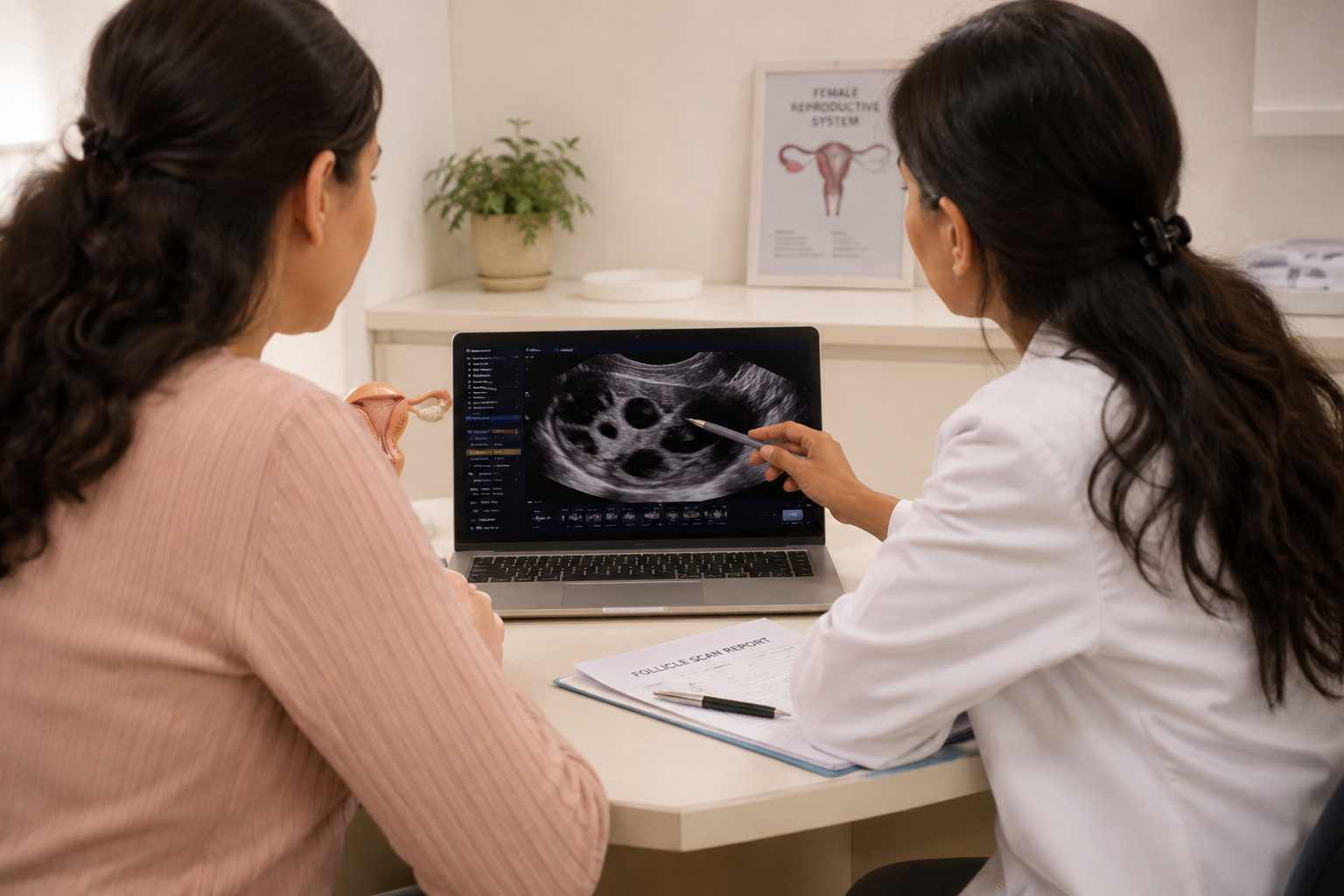
Getting evaluated isn't the same as starting IVF. Most work-ups begin with a straightforward set of blood tests, an ultrasound to check your ovarian reserve and uterine cavity, and a semen analysis for your partner. What that picture shows determines whether the next step is simply better-timed natural attempts, ovulation induction, or assisted reproduction. For a good number of women in this age group, it turns out to be less involved than they'd feared.
- If you're under 35 and have been trying for 12 months without success, get evaluated
- If you're 35 or older and have been trying for 6 months without success, get evaluated
- If you're 40 or older, don't wait for a fixed number of months at all. Book a consultation as soon as you start trying, so any needed treatment isn't competing with time you can't get back
- Regardless of age, seek evaluation sooner if you have very irregular or absent periods, a known condition such as PCOS, endometriosis, or fibroids, a prior pelvic surgery, or if your partner has a known fertility concern
What to ask at your appointment
Bring these questions along. They'll tell you quickly whether the evaluation you're being offered is actually complete.
- What does my AMH mean alongside my antral follicle count, not on its own?
- Based on my numbers, are we looking at natural conception, ovulation induction, or IVF as the realistic first step?
- If I'm not ready to try yet, does egg freezing make sense for me now, and how many eggs would we be aiming for?
- Has my partner's semen analysis been done? Roughly a third of infertility involves a male factor
- What's a realistic timeline before we'd consider changing the plan?
When to see a fertility specialist
Book a consultation if you're 35 or older and have been trying for six months, if you're 40 or older and are just starting to try, if your cycles have become irregular, or if you're considering egg freezing and want to know where your numbers actually stand before deciding. Bring any previous hormone or ultrasound reports you have, they let a fertility specialist read your trend over time instead of a single snapshot.
If you're in North or West Delhi, consultations are available at Raheja Clinic in Vijay Nagar and at C K Birla Hospital, Punjabi Bagh.
Resources
Common questions
Can I still get pregnant naturally after 35?
Yes, and most women in this age group do. Fertility declines gradually through your 30s and more steeply after 35, but declining isn't the same as unlikely. The main practical difference is that the window to notice a real problem and act on it is shorter, which is why the recommended waiting time before seeking evaluation drops from 12 months to 6 months at this age.
Is a low AMH the same as being infertile?
No. AMH measures how many eggs are likely left, not whether you can conceive. Several studies following women trying to conceive naturally have found similar monthly pregnancy rates across a wide range of AMH levels, as long as ovulation is normal. A low AMH matters more for planning IVF stimulation than for predicting natural fertility, and it should always be read alongside antral follicle count and your full history, never on its own.
Should I freeze my eggs if I am not sure I want children yet?
It depends on your age, how uncertain your timeline is, and what you're prioritising, but it's worth a serious conversation, especially before 38, when outcomes are strongest. Egg freezing doesn't guarantee a future pregnancy, and most women who freeze electively never actually end up using the eggs, often because they conceive naturally in the meantime. Its real value is preserving your options while your egg quality is at today's level rather than a later one.
How much does egg freezing cost in Delhi?
Costs vary by clinic and by how many stimulation cycles are needed to bank a useful number of eggs, plus ongoing annual storage fees. This is best discussed directly at consultation once your ovarian reserve has been assessed, since the number of cycles required depends on how you individually respond.
Does IVF fix age-related egg quality decline?
No, and this is one of the most common misconceptions. IVF can address many causes of infertility, like blocked tubes or ovulation disorders, but it can't make an older egg's chromosomes behave like a younger egg's. IVF success rates using a woman's own eggs fall with age for the same underlying reason natural conception rates fall. Where IVF changes the picture most is with donor eggs, where age-related egg quality is no longer the limiting factor.
What is the male partner's role in fertility after 35?
A significant one. Roughly a third of infertility cases involve a male factor, and sperm quality also declines with age, just more gradually than egg quality. A basic semen analysis is quick, inexpensive, and often done in the very first visit, alongside the female partner's assessment.
I have PCOS and I am over 35, what changes?
PCOS itself doesn't speed up egg quantity decline, but it does complicate ovulation, and combining irregular ovulation with age-related changes narrows your effective window further. If you have PCOS, are over 35, and are trying to conceive, an expedited evaluation and earlier use of ovulation induction is usually the right approach rather than waiting it out.